

| Lou Hildebrandt |
Following Algerian boxer Imane Khelif’s victory in Olympics a few months ago, a debate as malevolent as controversial flared up on Twitter, where racism, misogyny and trans-misogyny alarmingly and appallingly coincided. Donald Trump, Elon Musk, J. K. Rowling, and other prominent people with a huge reach ranging from alt-right to right-wing extremist audiences caused this eruption of discriminatory comments, but even supposedly progressive people’s responses lacked critical differentiation.
A BRIEF SYNOPSIS OF WHAT HAPPENED
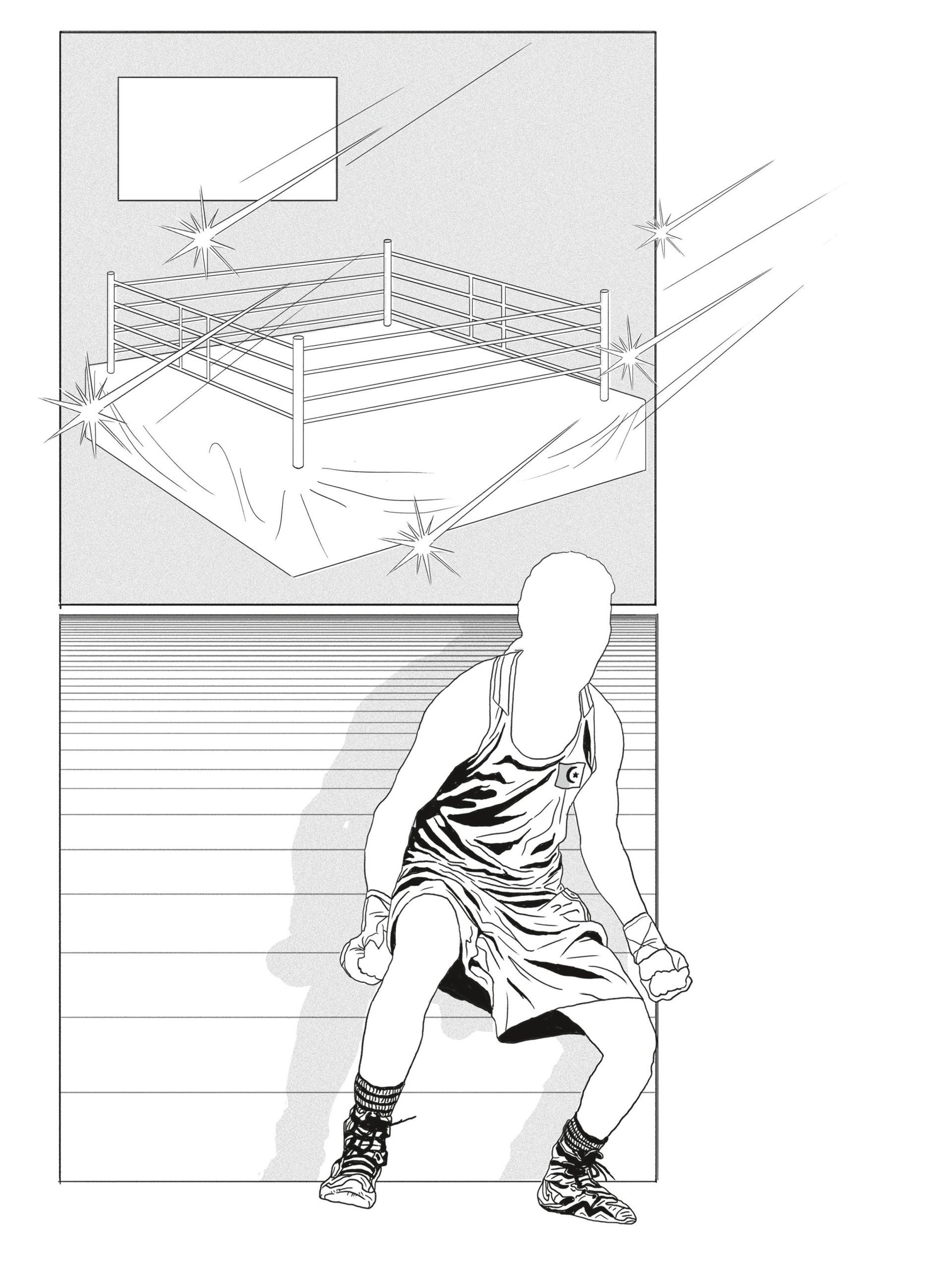
In 2024, Imane Khelif participated in the Olympic women’s boxing competition. In her opening match, the Algerian athlete defeated Angela Carini, her Italian competitor, in under a minute. Following the match, Carini refused to shake Khelif’s hand, sparking a wave of hate on Twitter against Imane Khelif.
Hateful tweets focused on Khelif’s gender identity and accused her of being a man. Many, like J.K. Rowling — whose trans-misogyny does not come as a surprise — reproduced structural violence in particularly discriminatory comments. People like her are so-called “TERFs” — trans-exclusionary radical feminists — whose activism does not aim at emancipating women but at excluding and marginalizing trans women (Marshall, 2024). With her tweet, Rowling reinforced the immensely offensive and oppressive narrative of trans-women being deceptive men disguised as women, who try to enter women’s spaces, specifically sports, and cause harm to cis — whom they consider “real” — women. Perhaps, in the scenario at hand this narrative brings about even greater harm than in other disciplines, because boxing is about people having a physical combat and such a perceived unfair advantage would cause the other female opponent to endure physical pain. The trans-misogynistic imagery of a man hitting a woman streamed on TV likely appeals to our original sense of justice and urge to protect someone weaker in terms of body physics. Since boxing relies so heavily on advantage in strength over the opponent, the trans-misogynist narrative of trans women’s “unfair advantage” in sports thus appears more plausible at first glance, backing up the trans-misogynist narrative and worldview. Within this reactionary escalation on Twitter, Imane Khelif was defamed, judged by others, and her womanhood was denied. Public figures with a great reach like Elon Musk or Donald Trump also engaged in this social media debate of both false information and spread of hatred. Donald Trump even re-opened the hateful debate on Imane Khelif and instrumentalized it for his electoral campaign in November 2024: He released an ad featuring a clip of Imane Khelif with the statement that Americans had chosen the wrong pathway by voting for Biden, since it was now possible that men assail women in sports (Monteil, 2024).
THE LEFTIST RESPONSE LACKS CRITICAL DIFFERENTIATION
Even within progressive spaces, many peoples’ reactions showed little sensitivity toward the specific issue of trans-misogyny. There were some that focused on the issue of racism, stating that the reactions were only so hateful because a white woman was being outperformed by a non-white woman. Many reacted to the reactionary right-wing hate tweets by simply pointing out that Khelif is not actually a trans woman.1 Whilst this was supposed to defend Imane Khelif, it uncovers an even deeper issue: What if she were a transgender woman ? This kind of argument centers the information, that Imane Khelif is not a transgender woman, whereas it should be clarified that the reactionaries’ manner of violating Imane Khelif’s personal rights and identity as a woman is inacceptable irrespective of her specific identity. The information may be important to Imane Khelif but considering the long and brutal trajectory of racism and trans-misogyny, it plays a minor and negligible role in the face of the colonial continuities this debate springs from.
Generally, it is disputable whether debates on Twitter are a productive means of exchange. In this case however, the counter-tweets failed to address the core issue of racism and the defamation of trans women. These tweets do not advocate for not judging Khelif’s womanhood because it is no one else’s business. Instead, they leave the door open to the speculation about what would happen if she were trans, implying that the accusations would be more acceptable if so.
ANTI-MUSLIM RACISM COMES A LONG WAY
The denial of the womanhood of MENA-women, or gender-specific forms of anti-Muslim racism, has a long history. Anti-Muslim racism intensified in the context of large migration waves to Europe and the U.S. in the second half of the twentieth century. Additionally, conflicts in the Mashriq — such as the occupation of Palestine, the Gulf Wars, the aftermath of 9/11, the “War on Terror”, and the revival of American imperialism in Iraq and Afghanistan — have fueled anti-Muslim racism across media, culture, and politics (Rana, 2007).
What makes anti-Muslim racism appear different to other forms of racism is the theoretical question of whether religious hatred can also be the bedrock of racism, adding layers of complexity. “Muslims” do not form a homogenous category, just as Islam is not a transhistorical essence. Racism usually involves the essentialization of certain traits — initially, biologicalized features were central to this. Today, it’s just as common to essentialize culture, leading to differential cultural racism. One can similarly argue that religious markers are essentialized, contributing to the structural fueling of hatred within a specific historical-political context. In the case of the “War on Terror”, it was not possible to rely on religious or cultural markers alone; biologicalized ones almost always play a role. The ‘racialization’ of Islam — where religion becomes racialized and Muslims are treated as a homogenous racial group — reflects the long history of racism, where superficial traits like skin color or religion are used to justify discrimination. More simply put, the “race-ing” of Islam mirrors the long genealogy of racism itself and it is also linked to the relationship of Islam with the enslavement of Black peop- le in the U.S. and its role within the Black diaspora (Rana, 2007).
MENA-WOMEN AT THE INTERSECTION
OF GENDER-OPPRESSION AND ANTI-MUSLIM RACISM
The harsh expectations, judgement, and ultimately oppression of women on the basis of their looks, behavior, and overall being, are even worse for MENA-women, who face anti-Muslim racism in addition to gender-based oppression. MENA-women are less able to meet Eurocentric standards of femininity than white women. This is due to their non-European features, a point Moshtari Hilal explores in her book Hässlichkeit (2023, “Ugliness”). Power and wealth are tied to the white world, and therefore whiteness manifests in our psyche as something desirable. As a consequence, Hilal’s decolonial and psychoanalytic analysis highlights that only the white man is seen as a deserving human being (Hilal, 2023). The fact that Imane Khelif is not only accused of defeating her opponent unfairly but has her entire gender identity called into question, demonstrates the extent to which white people fail to respect MENA-women as human beings.
This regulation and policing of women’s bodies showcases how, even though Imane Khelif is not a trans woman, a dominant Eurocentric standard of femininity still judges marginalized bodies, showing how trans-misogyny and anti-Muslim racism go hand in hand. The two forms of oppression have in common that women forfeit their agency through other people questioning their right to participate in public spaces. For both women of Color and trans women, femininity is not something they “have” but something they must constantly prove, which shows how gender is an oppressive racist ideology.
WE ARE WITNESSES TO COLONIAL CONTINUITIES
The interconnectedness of colonial oppression, trans-misogyny and racism, can be dismantled through analyzing their similar structures of power and hierarchy. What happened in the context of the debate about Imane Khelif — how her own identity became the object of other peoples’ views — is part of a broader colonial legacy. Fanon, for instance, offers an existentialist analysis of how identity and consciousness of colonized peoples are destroyed and brutally subordinated to imperial societies. On this note, he writes that colonialism is the systemic negation of the other person and the denial of their attributes of humanity (Fanon, 1961). He also writes: “The [person] of color encounters difficulties in elaborating [their] body schema. The image of one’s body is solely negating. It’s an image in the third person” (Fanon, 1952).
This is exactly what can be witnessed in the debate about Imane Khelif, because it was not simply that she was not depicted positively after her victory, nor was she generally treated unfairly, but her whole identity was questioned and taken out of her hands to define. Fanon states that colonized people have no ontological resistance in the eyes of the imperial society (Fanon, 1952), which is a very crucial idea when analyzing what was done to Imane Khelif: Her whole being was not deemed respectable enough and people did not see any boundaries or limits at all when it came to judging her.
- For example, Tim Vollert’s Twitter-posting from 08/01/24 with 1.2 Million views reads: “Das ist absolut wahnsinnig. Twitter explodiert vor Wut weil eine Transfrau bei Olympia im Boxen gewinnt. Problem nur: Beide Personen sind als Frauen geboren, keine der Personen ist Trans. Fake News sind hier außer Kontrolle” — Engl.: “This is absolutely insane. Twitter is exploding from rage over a trans woman winning in the Olympics. The problem is that both people were born as women and neither person is trans. Fake news are out of control here”
link: https://x.com/tim_vollert/ status/1819029059772240061 ?s=12&mx=2; accessed on: 01/22/2025. ↩︎